
Running Overuse Injuries: What Load and Gait Can Tell You
Key takeaways
- Reported annual incidence varies widely by definition and population, but studies commonly find that a large proportion of recreational runners — often cited between 30% and 79% depending on the cohort and injury definition — experience a running-related injury in a given year.
- The dominant cause of running-related injury is training error: too much load applied too quickly, without adequate recovery, relative to what the tissue is currently adapted to.
- Wearables cannot prevent injury by themselves, but they can make load and asymmetry visible, which supports better training decisions. The evidence supports load management as the lever, not the device.
Running injuries are not accidents
Very few running injuries happen because of a single traumatic event. The overwhelming majority are overuse injuries: tissue is loaded repeatedly, recovery is insufficient, damage accumulates faster than repair, and eventually the tissue fails. Plantar fasciitis, Achilles tendinopathy, tibial stress injuries, patellofemoral pain and stress fractures all follow this shape.
The mechanism is cumulative, which means it is also, in principle, predictable and interruptible.
Training error is the dominant risk factor
Across the sports medicine literature, the most consistent modifiable risk factor for running-related injury is a rapid increase in training load. Not your arch height. Not your foot strike pattern. Load, applied faster than the tissue can adapt to it.
Bone, tendon, and fascia all remodel in response to stress, but they remodel slowly — on a timescale of weeks, while your cardiovascular fitness improves on a timescale of days. This mismatch is the trap: you feel able to run more before your tissues are able to tolerate more.
What actually changes before an injury
Before an overuse injury becomes painful, several things typically change in the way you move:
- Load starts shifting to one side. You subtly favour the leg that feels better.
- Ground contact time increases on one foot relative to the other.
- Pressure concentrates in a smaller area of the foot rather than distributing across it.
- Cadence drops as fatigue accumulates within a run.
None of this is visible to you while it is happening. It is also invisible to a wrist-worn device, which measures acceleration at your wrist rather than force at the ground.
An important honesty note about asymmetry
It would be convenient to claim that asymmetry reliably predicts injury. The evidence does not fully support that. Large prospective studies of runners have produced mixed findings on whether baseline gait asymmetry predicts who gets injured — some find an association, some do not.
What is better supported is the value of tracking change within an individual over time. A runner whose loading pattern shifts noticeably from their own baseline, particularly in combination with a jump in training volume, is a runner worth paying attention to. The signal is deviation from your own normal, not deviation from a population norm.
A load management approach that works
- Increase weekly volume gradually rather than in jumps. Sudden step-ups are where injuries live.
- Treat intensity as load. A hard interval session is not a recovery week just because the mileage was low.
- Watch consecutive hard days. Tissue repair needs time, not just sleep.
- Track how the load distributes, not only how far you ran. A 10k where one foot took disproportionate load is not the same 10k.
- Respond to change early. Backing off for three days is cheaper than backing off for three months.
Where foot-level data helps
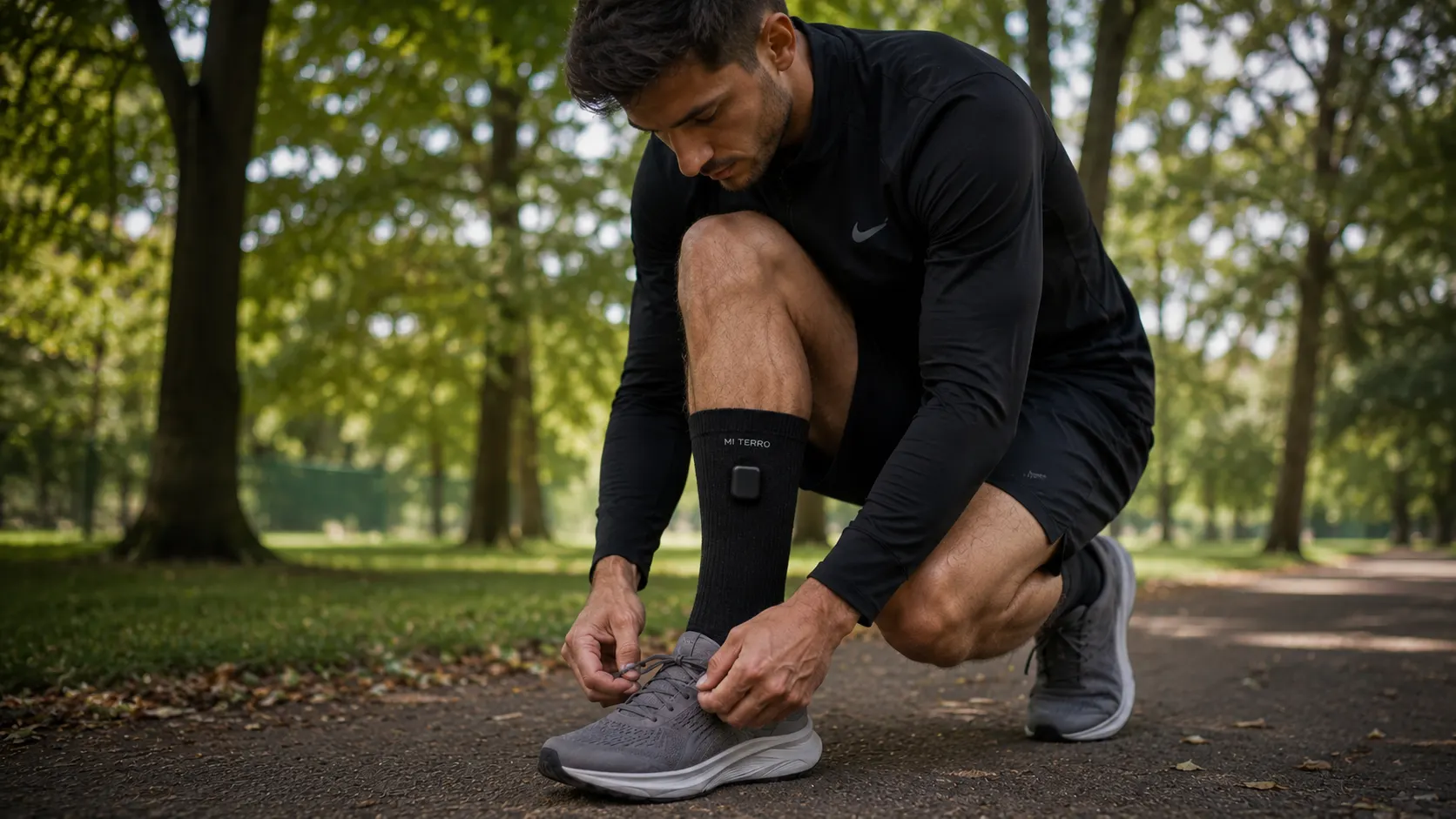
The foot is where force enters the body. Measuring pressure and gait at the sole adds variables related to tissue loading rather than relying only on movement measured at the wrist. Mi Terro Care Socks are designed to make that foot-level layer easier to review.
Frequently asked questions
What percentage of runners get injured?
Reported annual incidence varies widely by definition and population, but studies commonly find that a large proportion of recreational runners — often cited between 30% and 79% depending on the cohort and injury definition — experience a running-related injury in a given year.
What causes most running injuries?
The dominant cause of running-related injury is training error: too much load applied too quickly, without adequate recovery, relative to what the tissue is currently adapted to.
Can wearables prevent running injuries?
Wearables cannot prevent injury by themselves, but they can make load and asymmetry visible, which supports better training decisions. The evidence supports load management as the lever, not the device.
Sources and further reading
- Systematic Review of Running Overuse BiomechanicsInjury-specific evidence, conflicting findings, and research limitations.
- AAOS Foot and Ankle Conditioning ProgramGeneral conditioning guidance after injury or surgery.
See your own foot-level patterns.
Mi Terro is designed to track temperature, pressure, gait, and activity trends during daily wear. It supports awareness, not diagnosis.
Try Smart Socks NowMedical disclaimer: This article is general educational information, not medical advice. Mi Terro Smart Socks are not intended to diagnose, treat, cure, or prevent disease. Contact a qualified healthcare professional about symptoms, open wounds, sudden swelling, spreading redness, or other urgent concerns.