
Gait Asymmetry: What It Means and What It Does Not
Key takeaways
- No. Everybody has some degree of natural asymmetry. Small left-right differences are normal and not inherently pathological.
- The evidence is mixed. Some studies find associations between asymmetry and injury; large prospective studies have not consistently shown that baseline asymmetry predicts who gets injured.
- Change from your own baseline. A shift in your own loading pattern over time is more informative than how you compare to a population average.
Everyone is asymmetric
Humans are not symmetrical machines. Leg length differs slightly, limb dominance exists, and small left-right differences in ground contact time and loading are ubiquitous in healthy, uninjured people.
This is the first thing that gets lost in wearable marketing: a device telling you that you have 4% asymmetry is not telling you that something is wrong.
Where the evidence actually stands
It is tempting to claim that asymmetry predicts injury, because it makes for a clean product story. The literature does not support a clean story.
Some cross-sectional studies find that injured runners display more asymmetry than uninjured ones — but that is measuring people who are already injured, and injury causes asymmetry as much as the reverse. The prospective evidence, following uninjured runners forward in time to see who gets hurt, is considerably less convincing. Large studies have failed to establish baseline asymmetry as a reliable predictor.
Being straight about this is more useful than selling a false certainty.
What asymmetry does usefully tell you
- That you are compensating. If you have an injury, surgery, or pain, asymmetry quantifies how much you are avoiding one side. This is genuinely useful in rehabilitation.
- That something has changed. A shift from your own established pattern is worth investigating, even if the absolute number is unremarkable.
- That fatigue is affecting you. Asymmetry that grows over the course of a long run tells you something about how you are holding up.
The right frame: within-person change
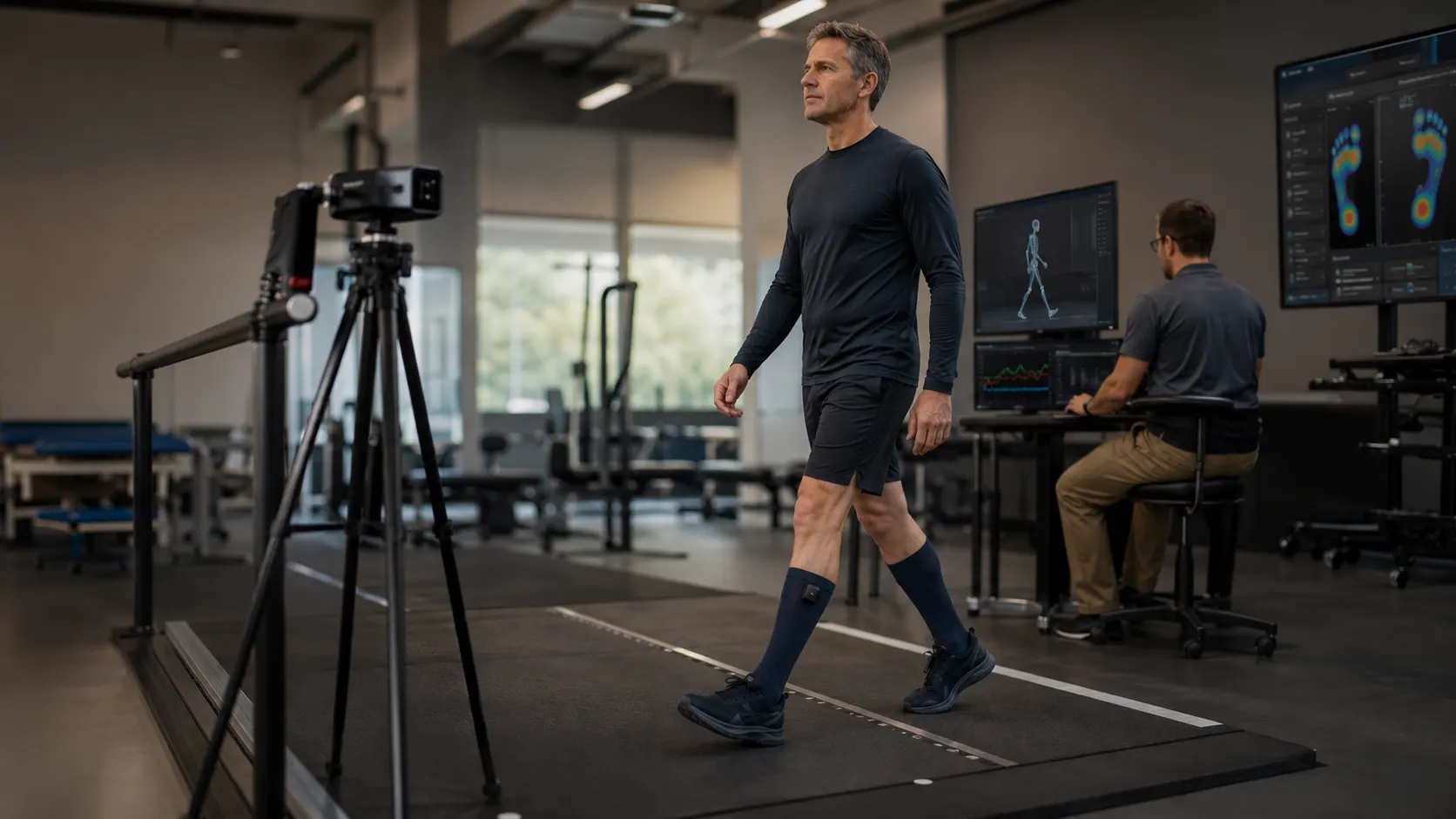
The most defensible use of gait data is longitudinal and personal. You are the control group. If your loading pattern has drifted noticeably from your own baseline over three weeks, that is a signal — regardless of whether the number would look normal on a population chart.
This is how Mi Terro Care Socks are designed to be used: tracking your trend, not scoring you against a norm. It is a less dramatic claim, and it is the one the evidence actually supports.
Frequently asked questions
Is perfect gait symmetry normal?
No. Everybody has some degree of natural asymmetry. Small left-right differences are normal and not inherently pathological.
Does asymmetry cause injury?
The evidence is mixed. Some studies find associations between asymmetry and injury; large prospective studies have not consistently shown that baseline asymmetry predicts who gets injured.
What is more useful than absolute asymmetry?
Change from your own baseline. A shift in your own loading pattern over time is more informative than how you compare to a population average.
Sources and further reading
- Systematic Review of Running Overuse BiomechanicsInjury-specific evidence, conflicting findings, and research limitations.
- Systematic Review of Gait Stability MeasuresEvidence and limitations of biomechanical gait stability measures in older adults.
- Prospective Study of Gait Variability and FallsOne-year prospective study of stride-to-stride gait variability and falls.
See your own foot-level patterns.
Mi Terro is designed to track temperature, pressure, gait, and activity trends during daily wear. It supports awareness, not diagnosis.
Try Smart Socks NowMedical disclaimer: This article is general educational information, not medical advice. Mi Terro Smart Socks are not intended to diagnose, treat, cure, or prevent disease. Contact a qualified healthcare professional about symptoms, open wounds, sudden swelling, spreading redness, or other urgent concerns.