
How Often Should Diabetic Feet Be Checked? Risk Categories Explained
Key takeaways
- At minimum annually for those with no risk factors. People with neuropathy, deformity, peripheral arterial disease, or a history of ulcer require substantially more frequent review — in the highest-risk categories, every one to three months.
- A previous foot ulcer or amputation is the single strongest predictor of a future ulcer. Loss of protective sensation, peripheral arterial disease and foot deformity all increase risk.
- It substantially raises the risk. Recurrence rates after a healed diabetic foot ulcer are high, which is why post-healing surveillance and offloading footwear matter so much.
Not everyone with diabetes has the same feet
A person newly diagnosed with type 2 diabetes, with intact sensation, good circulation and no deformity, has a low absolute risk of foot ulceration. A person with neuropathy, a previous ulcer and a clawed toe has a high one. Applying the same screening interval to both wastes effort on one and endangers the other.
This is why international diabetic foot guidance stratifies risk and sets the review interval accordingly.
The variables that determine risk
- Loss of protective sensation, assessed with a 10g monofilament.
- Peripheral arterial disease, assessed by pulses and, where indicated, ankle-brachial index.
- Foot deformity, such as claw toes, hammer toes, bunions, or Charcot change.
- Callus, which marks a pressure concentration.
- A previous ulcer.
- A previous amputation.
- End-stage renal disease, which markedly increases risk.
How the categories work, in principle
- No neuropathy, no peripheral arterial disease, no other risk factors: annual review.
- Neuropathy, or peripheral arterial disease, or deformity: more frequent review, typically every few months.
- Neuropathy plus peripheral arterial disease, or plus deformity: frequent specialist review.
- Previous ulcer, previous amputation, or end-stage renal disease: the highest-risk category, with review often every one to three months.
The exact intervals vary between guidelines and health systems. The principle does not: risk determines frequency, and previous ulceration is the strongest single flag.
The gap between appointments
Even in the highest-risk category, a review every eight weeks means roughly 56 days between examinations. A diabetic foot ulcer does not take 56 days to form. This is the fundamental limitation of episodic screening: the surveillance interval is longer than the disease process.
This is not a criticism of the guidance, which is sensible given finite clinical resources. It is an argument for what fills the gap.
What continuous monitoring is for
Daily self-inspection is one answer, and it is the standard recommendation. Continuous sensing is another, and it does not depend on the patient remembering, seeing well, or being able to reach their feet.
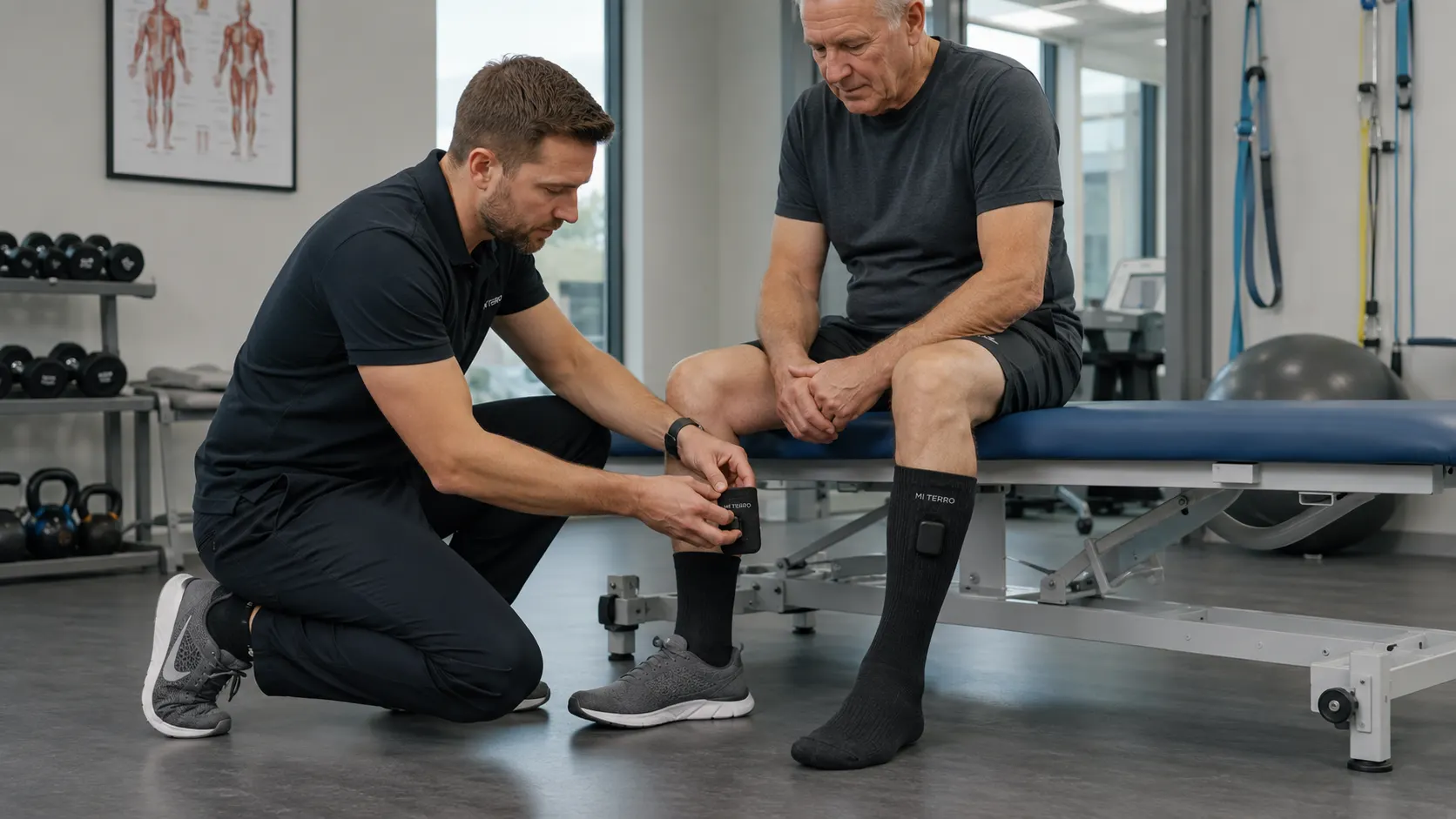
Mi Terro Care Socks are designed to add temperature, pressure, gait, and activity context between appointments. They do not replace daily inspection, risk-based screening, or professional review.
Frequently asked questions
How often should a person with diabetes have a foot exam?
At minimum annually for those with no risk factors. People with neuropathy, deformity, peripheral arterial disease, or a history of ulcer require substantially more frequent review — in the highest-risk categories, every one to three months.
What makes someone high risk?
A previous foot ulcer or amputation is the single strongest predictor of a future ulcer. Loss of protective sensation, peripheral arterial disease and foot deformity all increase risk.
Does a previous ulcer mean I will get another?
It substantially raises the risk. Recurrence rates after a healed diabetic foot ulcer are high, which is why post-healing surveillance and offloading footwear matter so much.
Sources and further reading
- IWGDF 2023 Prevention GuidelineInternational guidance for prevention and risk-based care of diabetes-related foot disease.
- NIDDK: Diabetes and Foot ProblemsDaily foot care, temperature concerns, footwear, and when to contact a clinician.
- NIDDK: Peripheral NeuropathySymptoms, balance effects, examinations, and daily foot care.
See your own foot-level patterns.
Mi Terro is designed to track temperature, pressure, gait, and activity trends during daily wear. It supports awareness, not diagnosis.
Try Smart Socks NowMedical disclaimer: This article is general educational information, not medical advice. Mi Terro Smart Socks are not intended to diagnose, treat, cure, or prevent disease. Contact a qualified healthcare professional about symptoms, open wounds, sudden swelling, spreading redness, or other urgent concerns.